

Within You, Without You
Two veteran groups tackle big issues, with generally positive results: Gorillaz consider mortality and the afterlife, while U2 rages against the age of autocracy.


Gorillaz - The Mountain
Gorillaz ringleader Damon Albarn has often used his cartoon conceit to offer trenchant commentary about the dehumanizing elements of consumer culture. A new album called The Mountain offers something altogether different— a surprisingly vulnerable reckoning with loss, grief, and spiritual questing. I reviewed it for FLOOD:
What could be more rock-and-roll than a spiritual pilgrimage to India? If it was good enough for The Beatles, then it’s certainly good enough for Damon Albarn, Jamie Hewlett, and their cartoon recording project Gorillaz. Their ninth album is called The Mountain, and it’s born of just such a quest: Before they wrote these songs, both Albarn and Hewlett experienced the death of loved ones, grief they tried to process via Indian retreat. From the transcendent album cover to the opening title song (a five-minute instrumental prelude played on traditional Indian instruments), it’s clear that this is a different kind of Gorillaz album—frequently interior, occasionally existential, surprisingly heartfelt.
Not for nothing, it’s also one of their best, as ambitious and absorbing as anything they’ve done since 2010’s Plastic Beach. Make no mistake that this remains a Gorillaz album through and through, full of electro-pop bangers hardwired to the thump and clatter of old-school hip-hop. But there are also sitars and other Indian instruments, played by some of the country’s most acclaimed musicians, that float in and out of these songs, providing some local color and spiritual flair. There are also lyrics, melodies, motifs, even individual voices that spill over from one track into the next, giving the entire piece a sense of cohesion. Albarn provides the connective tissue with his signature bleeps and bloops, his sadsack croon, and his earworn melodies, conveying fragile beauty and abiding melancholy.
It’s a terrific album. You can read my full assessment here.
My rating: 8 out of 10.
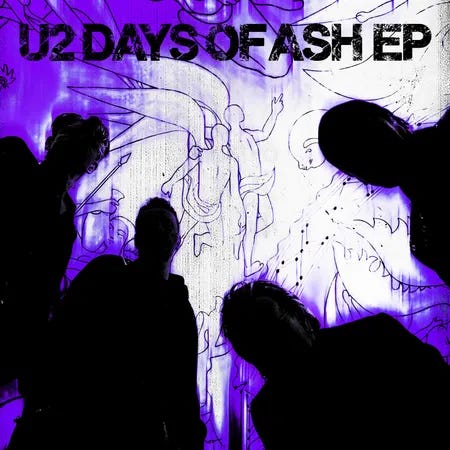
U2 - Days of Ash
“American Obituary,” the lead-off track on U2’s new Days of Ash EP, makes specific mention of the killing of Renee Good on January 7, 2026— a topical reference still burned in the public consciousness on Ash Wednesday, the day the song was released. That means U2 wrote, recorded, and released the song in right around 40 days’ time, an absolutely harried pace for a band that’s famously slow in the studio and increasingly paralyzed by their calculating nature. The rush release speaks to a real sense of urgency about the state of the world, and about U2’s responsibility to address it; it suggests a sense of directness inspired by their beloved early punk records, maybe not in sound but certainly in spirit. The great critic Stephen Thomas Erlewine puts it best: “Things have gotten so bad in the world that U2 has decided to stop second-guessing themselves.”
The mere fact that this band is finally breaking some bad habits— namely, their own indecision— should be an encouragement to fans who worried that U2 was only going to grow more hapless and irrelevant. It’s been at least 20 years since the group really sounded sure-footed, and their output in recent years has been both infrequent and underwhelming. So while the songs on Days of Ash aren’t top-tier U2 songs— only the soaring “The Tears of Things” even comes close— the reality of them loosening up and not overthinking feels like a big step. And even with middling material, there’s just enough of the old spark here to suggest U2 may have more in the tank after all.
They recorded these songs with producer Jacknife Lee, a classicist producer who’s also made albums with R.E.M., Weezer, and The Killers. There are six tracks total: Four perfectly fine, vintage-soundingU2 songs, a spoken word piece penned by Israeli poet Yehuda Amichai, and a try-hard team-up with singer Ed Sheeran. Every track addresses global dysfunction, sometimes with specific names and ripped-from-the-headlines details, other times with the band’s trademark universality.
That universality doesn’t serve them as well here as it did on, say, All That You Can’t Leave Behind, and those expecting hard-hitting stances against social injustice or rising fascism may be disappointed by Bono’s increased tendency toward toothless boomer jibber-jabber. “You have the right to remain silent— or not,” he intones at the album’s start, later reminding us that love is not a noun but a verb and that the power of the people is greater than the people in power. But if their protests can sound generic, they never sound dispassionate: With its siren-like guitars and Achtung Baby-era sound effects, “American Obituary” announces that the 2026 model of U2 has some kick. They give a shit.
The band’s general loss of confidence means they often sound like followers rather than leaders; once upon a time it seemed like Coldplay was auditioning to be the next U2, but the Sheeran collaboration “Yours Eternally” finds U2 straining to emulate Coldplay’s perky, featherweight pop. But on “The Tears of Things,” the old magic is still there. Bono weaves historical and biblical imagery to create a moving lament over cyclical violence; The Edge’s chiming solo is perfunctory, an autotuned vocal section seems gratuitous, and yet when that soaring chorus lifts off, it’s a reminder of how majestic U2 can be when they’re at their best. Days of Ash isn’t their best, but it comes close enough to make one glad U2 is still shining light into a dark world.
My rating: 6 out of 10.
Other recent favorites: