

Twisted Tales
The New Orleans duo Twisted Teens have made an exemplary punk record: fast, funny, and wonderfully ragged. It's also steeped in country twang and arcane Americana.

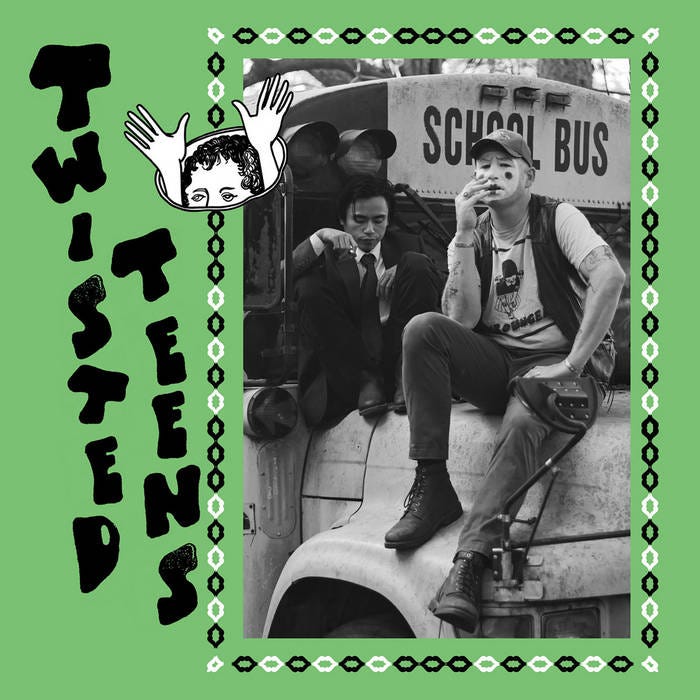
Twisted Teens - Blame the Clown
The title comes from a strange axiom deployed by singer Caspian Hollywell close to the album’s end. “I don’t blame the circus, I blame the clown,” he shrugs, sounding as tender as a grandfather and as hardscrabble as a drifter. It’s an unusual turn of phrase that sounds almost like some bygone idiom, a cliche that’s passed through so many generations that its meaning has gotten fuzzy, its cultural particulars lost to the sands of time.
That’s the Twisted Teens in a nutshell: What Blame the Clown lacks in literal or narrative sense it more than makes up for with emotional logic. This is a group that deploys in-jokes and arcana to maximum effect, creating their own insider language that welcomes listeners to eavesdrop even while refusing to fully explain what it all means.
Maybe it’s better, then, to start not with meaning but with sound. Blame the Clown is a beguiling and utterly arresting punk record; with 12 songs blazing by in 30 minutes flat, it’s well-paced and perfectly portioned. It’s a riotous blur of gruff vocals, slashing guitars, thumping drums, and oddball sound effects, all offered without an ounce of varnish. The music frequently pushes into the red; static and hiss abound. The whole thing sounds like a tape that was dropped in a river and remains just a little bit waterlogged. It’s as crude and rough-edged as you’d hope from the next big name in garage rock.
All that ruckus, and the Twisted Teens number just two. It’s hard to remember the last rock and roll duo where both members brought so much distinct personality to their recordings— Jack and Meg, maybe? There’s Honeywell, of course, whose raspy croon carries the perfect blend of world-weariness and old-world romance; at times he sounds like early Tom Waits, a chain smoker who narrates guttersnipe tales with equal parts cynicism and affection. Joining him is the perfectly-named “Razor” Ramon Santos, a steel guitar maestro whose loquacious, dexterous playing fills these songs with thrumming energy— the slash ‘n’ thrash of punk, but also plenty of high-and-lonesome country twang.
Hailing from New Orleans, the band plays with a swaggering, block party sensibility— their songs feel conversational, improvisational, and loose. That’s certainly true when they keep things fast and dirty, as they do on pummeling numbers like “Is it Real?” and “Not Real",” both of which bear their existential angst right there in their titles. But the Twisted Teens have also internalized the sound and structure of earthy Americana: “Peekaboo Hand” moves to a loping country gait, while the singalong “White Hot Coal” falls somewhere between a work song, a campfire ballad, and a sea shanty. The band’s pared-down instrumentation means that when they do add some additional color, it has a visceral effect: “Little Seed” has stride piano right out of a blues club, and “Who Could it Be?” dances to a jangling tambourine.
Twisted Teens have a sense of humor that’s both absurd and endearing, and it bears out in both their lyrics and their arrangements. The cheerfully locomotive “I Operate” relays the tragic account of a boy who got circumcised at age 10; wait til you hear what happened to the foreskin. “Little Seed,” which Honeywell sings with sweaty earnestness, is peppered with bizarre vocal ad-libs, as though an old-timey DJ is weighing in with in-track commentary. The album winds down with a tape collage instrumental, a graveyard postlude that’s equal parts “Tomorrow Never Knows” and “Everything in its Right Place.” It’s titled “Corpse Pose.”
That’ not to say there isn’t deep feeling in these songs. Look at some of those song titles again: “Are You Real?” and “Not Real” both suggest a hunger for something tangible, reliable, and authentic, a concern that looms large over lyrics that often speak to estrangement from the self or from others. Is “Not Real” a song about fake friends— or is it perhaps about untrustworthy voices within the narrator’s head? And what to make of “Who Could It Be?,” which sounds the alarm about some sinister, skulking stranger?
Crucially, the group never uses its absurdist streak as a way to evade candor; gruff and crude-sounding though it may be, Blame the Clown is remarkably open-hearted. One of the best songs is “Wild Connection,” an in-the-pocket country jam with Stonesy undercurrents; Honeywell delivers it in his most roguish croon, offering empathy and apology that sound completely sincere. Elsewhere, he peppers the album with his oddball slang and twisted proverbs. From “White Hot Coal”: “Pressure makes a diamond, I’m told/ But being diamond, it ain’t always gold.”
All the strange myths and jokes and truisms that fill the album invite an unexpected comparison: Blame the Clown almost sounds like a slanted take on Harry Smith’s Anthology of American Folk Music, or perhaps Dylan’s The Basement Tapes. That is to say, it plays like a compendium of old, weird Americana, a signature sound born of regional vernaculars and local particulars. It’s a thrilling record from a young band with a clear vision, and a gift for making that vision sound mysterious and welcoming all at once.
My rating: 8.5 out of 10.
Other recent favorites:
1) This album rules and 2) I was delighted to find that it was released by a little indie record label from my hometown.